Showing posts with label Boston. Show all posts

Thursday, September 1, 2011

Case Study 4.4: Conclusion

Time to finish up Boston. Long a powerhouse of the country, Boston is still a vibrant city with a host of businesses large and small forming the heart of a strong economy. One often reads about the high-tech startups in the Boston area, particularly in biotech, and many of the best and brightest choose to live in urban Boston. The large host of universities in Boston gives the city a young energy, not something it was once known for. Of greatest interest to me, however, is that all that money sloshing around often ends up in real estate. Charming historical neighborhoods like the ones I've featured in my case studies are among the finest in the country, well-maintained and treasured as historic assets. Many a fine home can be found in Boston.

Often described as the gateway to New England, Boston played a key role in the American Revolution, was a hub for the Civil War, and today continues has lost none of its importance. It's a shame, perhaps, that unlike Manhattan or San Francisco, the city's population hasn't concentrated on the peninsula but instead spread outward into the suburbs. Like most cities in the US, Boston is generally disposed towards suburbs, but neighborhoods like Beacon Hill show American urban living at its finest. 

In this conclusion are a few images of the North End and South End. I had hoped to make full case studies of both, but after a short while in the North End I realized it isn't really what I had expected. It's not residential enough for me, not affluent enough, with too many rough patches and not enough care given to preserve the historic fabric. It's the oldest part of Boston, site of the original British settlement, but that isn't really evident, apart from the dense and sporadic street pattern. I wish more old buildings like Paul Revere's home had survived. I have to say, I have a feeling the North End has served as a basis for cartoon urban neighborhoods. On the tv channel Nickelodeon, for example. The red bricks, density, etc. just reminds me of the shows from my youth. So here it is:


The South End also certainly deserves its own case study, but I had to bypass that for technical reasons, the fault of which lies with Microsoft. It would seem that except for a few main roads, they didn't see the South End worthy for Bing's Streetside images, so I had to make do with Google Streetview, which frankly doesn't meet standards. You can easily see the difference below. If anyone has contacts within Google, please ask them why Streetview blurs the top part of the image, and why don't they use cameras with a higher contrast ratio? The South End is another of those areas which has experienced a good deal of gentrification in recent years. The many multimillion dollar townhouses would have been unimaginable not long ago. There are several large garden squares, based on but larger than Louisburg Square in Beacon Hill. Another interesting street pattern divides the street by a very narrow park, of which a few examples can be seen below. South End is known as the largest urban Victorian neighborhood in the country, and is popular for its many bars, restaurants, and galleries.


The South End is undeniably a great area with many beautiful streetscapes and equally impressive homes. The most expensive home currently for sale in the South End is listed at $3.9 million! I think one of the challenges facing all cities right now is how to balance the quality of neighborhoods without completely giving way to gentrification. I won't argue that with gentrification usually comes an increased level of care for homes, streets, and parks, but this shouldn't be at the expense of less well-off residents. How then to ensure that landlords maintain their properties, so that the contrast between multimillion dollar homes and multifamily buildings is less disturbing? Especially considering that many landlords nowadays are large property management companies which may or may not be based in the area, let alone the same country? I had considered enforcing mandatory architectural reviews, but that would add a huge level of bureaucracy, which no one wants to deal with or fund. I think the only solution is an increased awareness of civic pride, an automatic sense of obligation. But really, that's about as likely as people caring about the beauty of their car or clothes. Not likely. Maybe it'll be different in twenty years.

I think I'll be heading south for the next case study, Washington DC perhaps. It's been on my list for a while. 

Monday, August 22, 2011

Case Study 4.3: Beacon Hill

Beacon Hill is perhaps the only neighborhood in Boston where the character of the original Boston can still be discerned relatively unaltered, with a healthy mix of homes, shops, and offices. Far denser than Back Bay and therefore not plagued by cars, a sense of community is palpable among the beautiful well-maintained homes. I should admit it's always been my favorite Boston neighborhood so perhaps I am slightly biased, though I am by no means the only one with a preference for historic row homes. Bordering Boston Common and the Public Garden, this has been the city's upper-class neighborhood since the late 18th century, especially the south slope of the hill facing the parks. Famous residents have included John Hancock, Robert Lee Frost, and more recently Edward Kennedy and John Kerry. Famous architect Charles Bulfinch also lived and designed many homes here. Acorn Street, allegedly the most photographed street in the country, is on the south slope, as is Louisburg Square, one of the most elegant squares in the country.

The north slope of the hill, roughly separated by Myrtle Steet, was traditionally an African-American area and home to Frederick Douglas and Harriet Tubman. A center of the abolitionist movement, north slope residents helped many slaves during its role on the Underground Railroad. After the Civil War, the north slope became increasingly settled by European immigrants and today it has many more apartment buildings than the south slope, though has itself experienced gentrification and is by no means cheap. The main commercial corridors is Charles Street, with the usual mix of boutiques, cafes, restaurants, etc.

With a population of about 10,000, Beacon Hill is also a preferred location for many of the city's institutions, such as the Boston Bar Association, American Meteorological Society, Harvard Musical Association, and of course the Massachusetts State House, by far the area's largest building. Unfortunately, the cream of society, once called Boston Brahmins, no longer sees the neighborhood as desirable, and like much of the country has moved to the suburbs and country clubs, leaving Beacon Hill behind for those with more discerning, urban tendencies. Still, homes in Beacon Hill sell for millions.

Read more about the history of Beacon Hill here.

Beacon Street, which faces Boston Common
Charles Street, the shopping area
Brimmer Street, which runs north-south, is the nicest area west of Charles Street, and was mostly developed around 1870
As you'll see, plenty of trees is not an uncommon sight in Beacon Hill
Bay windows are another signature feature of the neighborhood
By now you may have noticed the red brick sidewalks, one of the hallmarks of the neighborhood. The home with the yellow door is currently on the market for $2.2 million
Vine-clad buildings are also a common sight, as are gas-lit lamps
Temple Street runs north from the State House
How nice to have bay windows just above the front door, to survey the comings and goings, and the little front gardens are also great
Hancock Street is one of the north slope's most pleasant streets, lined with condo buildings
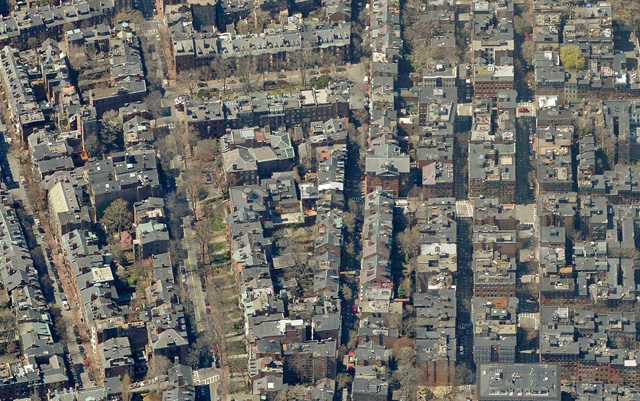
From above, the north slope looks remarkably dense considering that below it can be quite calm and quiet
Myrtle Street divides north and south slope and clearly has a more urban, less residential feel, though still charming
I think the sparse urbanism recalls inner city neighborhoods from cartoons I watched as a kid
Both in scale and architecture, this apartment building on Revere is unlike anything else in Beacon Hill
Beacon Hill is at its best when there's a procession of red brick rowhomes
Russell is my favorite street on the north slope, serene and beautifully maintained, it rivals the best of the south slope
North slope on the right, south on the left
West Cedar Street on the north slope, a well balanced streetscape with nicely contrasting left and right sides of the street
West Cedar on the south slope
A block further south, the street is more affluent. Wrought ironwork adds a lot of character to homes throughout the neighborhood
Apart from Charles, Joy Street is the only street to run clear across Beacon Hill north-south but the south side is significantly less severe
Pinckney is the furthest north street on the south slope and immediately we'll start to see a more refined quality compared to the north slope
They were a common sight in Charlestown, but homes oriented perpendicular to the street are rare in Beacon Hill
Architecture tends to be more expressive on the south slope, reflecting the area's wealthy past
It's hard to define exactly, but the south slope just feels more relaxed, more assured
The size of these homes! This is a place of grand gestures, although to my knowledge they are now split into condos
A mix of soft edges such as front steps, small gardens, and flower boxes, work together to enhance the streetscape
Preserving windows in a historical style is an important aspect of Beacon Hill's beauty
And so we arrive to Louisburg Square
Nice to see some cobbles, if only a thin sliver
Vine-clad buildings are taboo in the suburbs I'm from, good to see it not only acceptable but desired in urban America
It's curious that it's the only garden square in Beacon Hill, a few more wouldn't have gone amiss
I really like the more modest symmetry of the western side of the square
It's more classic Beacon Hill, classic Boston
Mount Vernon Street east of Louisburg Square is the only part of Beacon Hill with sizable front lawns
It's not altogether unpleasant, but there's a clear disconnect between the homes and streetscape
Chestnut is wider than most streets on the south slope
Beacon Hill is unique but yet so familiar, because it's the Boston we've all grown up with. The red rowhomes pop from the historical novels of our school days, from tourist guides and television shows. It's quintessential Boston and doesn't disappoint. I find it very difficult to find fault, but of course there are always some drawbacks. Like Back Bay, Beacon Hill used to directly abut Charles River, but a busy expressway now stands in between the neighborhood and the public esplanade. It's not an easy journey to get across and hardly encourages an easy Sunday stroll. To a lesser degree but still an issue, Beacon Street was once a relatively calm road but today is a busy four lane road, making it difficult to reach Boston Common and degrading the quality of life for homeowners. Most of the mansions along Beacon Street have long since been transformed into institutional offices as it's simply too busy and loud.

There's no getting away from the fact that prime Beacon Hill is bounded by Charles, Beacon, Joy, and Pinckney Streets, and while much of the rest of the neighborhood is also very nice, there are rough patches. Except for the north half of Brimmer Street, most of the neighborhood west of Charles Street is pretty commercial, with a lot of apartment buildings and not much greenery. And as we have learned, the tough past of the north slope has had a long lasting effect on the area's streets and architecture which has not entirely abated. 

My number one criticism, however, concerns the almost total lack of back gardens, a problem throughout urban Boston, including the Back Bay and Charlestown. Very few homes have any sort of garden, let alone one worth spending time in. Instead, many now host kitchen extensions or car parking. Some might argue that this lack encourages greater participation in the public realm, but finding respite in the comfort of ones' own garden is, I believe, far more relaxing on a quiet evening after work. That's not something the Boston Common, with its myriad of tourists and other visitors, can replicate. It also makes urban life with children more difficult, as the kids can't just go run about in the garden while dinner is being made. Many European cities like London have attained this balance much more effectively, boasting ample gardens even in dense urban areas. Perhaps rethinking those kitchen extensions might give less reason to flee to the suburbs?

Despite my reservations, I'm still a huge fan of Beacon Hill. It really is by far my favorite neighborhood in Boston, possibly the whole country. Certainly one of the best in New England. I've always liked a "northern" style of architecture and for that the red brick and rowhome is almost unbeatable. Residents in Beacon Hill have put in a lot of effort to retain the neighborhood's best features and the results speak for themselves. Street after street presents a beautiful streetscape and elegant, well-maintained homes. I wouldn't want to live anywhere else in Boston. 

Almost done with Boston. The conclusion post is next.